
More information does not automatically make the next decision clearer. | Image credit: Tanía Diaz / Ordinal
Businesses have become very good at making information visible.
Main takeaways
- Visibility does not guarantee a clear decision.
- More metrics can add context, or just another screen to interpret.
- The decision should determine the dashboard, not the reverse.
- Access to data and the capability to use it are different things.
- AI predictions are inputs to a judgement, not facts about the future.
A CEO can open a dashboard and see revenue by market, customer churn, pipeline, margins and forecasts. Operations teams can monitor capacity, delivery times and backlogs. More information can be collected, connected and analysed than most organisations could have imagined a decade ago.
Yet visibility does not guarantee a clear decision.
Research into organisational decision-making shows why. A study of 130 firms found that using big data did not directly improve decision quality. The relationship depended on the quality of the data and its diagnosticity: whether people could extract information that was useful for the decision they were trying to make.
For organisations investing in dashboards, analytics and AI, the question is therefore not simply what they can measure. It is what someone should be able to decide once the information is in front of them.

Visibility Can Leave the Decision Unresolved
Imagine a dashboard showing that customer cancellations have risen from 4% to 7%.
The change is easy to see. The response is less obvious.
Is the increase concentrated among particular customers? Did something change in the product, pricing or service? Is 7% outside normal variation? Does someone need to intervene now, and if so, who?
Adding more metrics might provide the missing context. It can also leave the person making the decision with another screen of information to interpret.
A 2024 review of research into information overload found that excessive information can contribute to poorer decision-making, reduced productivity and cognitive pressure. Importantly, the causes went beyond volume. The characteristics of the information, the task being performed, organisational conditions and the technology delivering the information all played a role.
So stripping dashboards back indiscriminately is not the answer either. A metric can be essential for one decision and irrelevant for another.
Start With the Decision
Consider a COO looking at delivery performance.
Knowing average delivery time may be useful, but the operational decision could be whether capacity needs to move between teams. That may require information about where delays are occurring, available capacity, customer impact and whether the problem is temporary or persistent.
A sales leader seeing conversion fall needs different information. The first decision may simply be whether the change requires intervention at all.
Starting with the decision changes what deserves space on the screen. It also forces organisations to ask who is expected to act, under which conditions and what information that person needs at that moment.
Research supports the importance of this organisational capability. A study of 240 agricultural firms in China found a positive relationship between big data analytics use and decision quality, with data analytics capabilities playing a mediating role.
The context is specific, but it illustrates a useful distinction: having access to data and having the capability to use it well are not the same thing.
AI Makes Prediction Easier, Not Certainty Possible
AI adds another layer because organisations can increasingly move from asking what happened to predicting what might happen next.
Which customers are likely to leave? Which sales leads are most promising? Where will demand increase? Which project is most likely to run late?
These predictions can be useful. They also need to be treated as predictions.
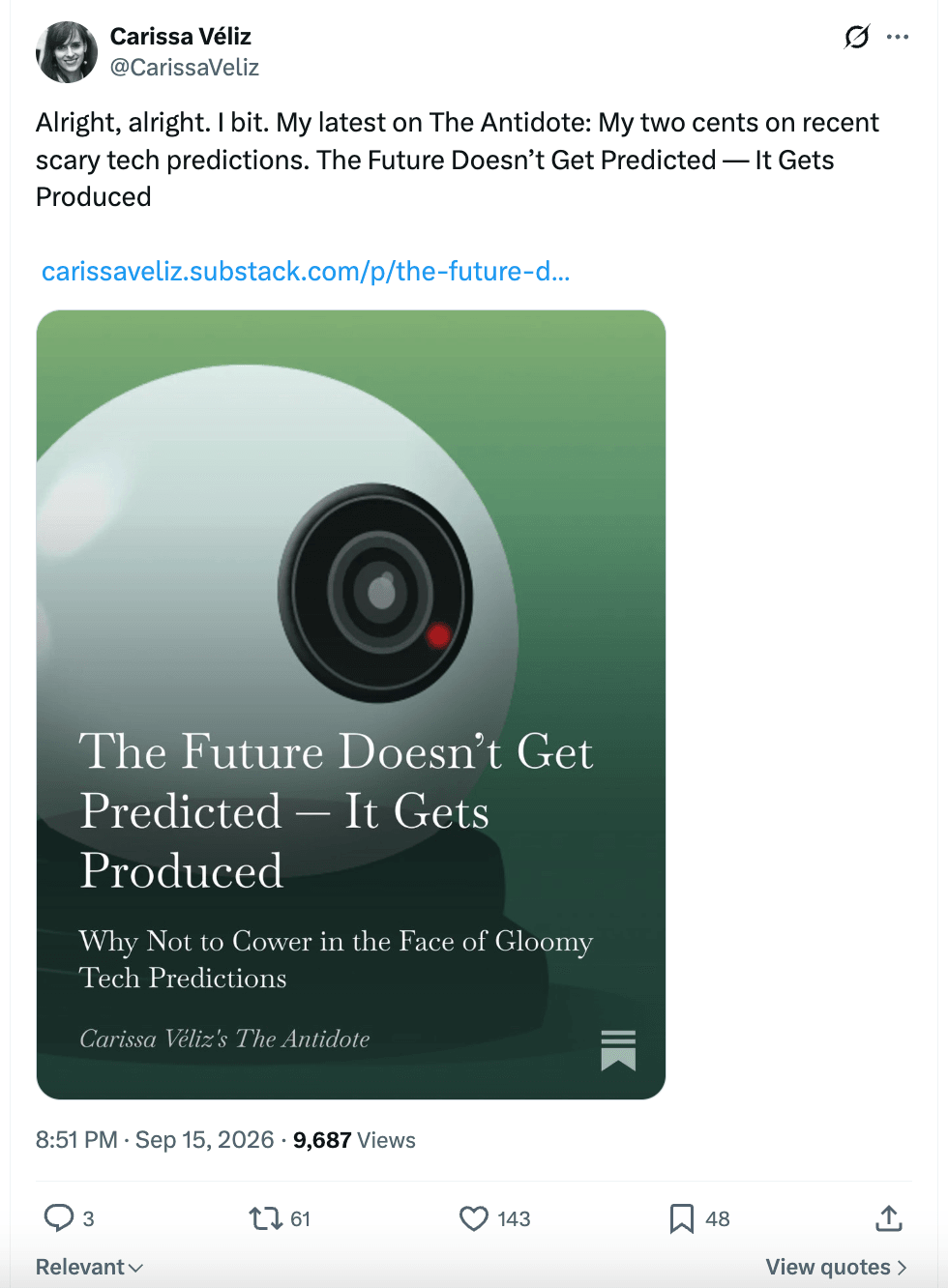
Oxford philosopher Carissa Véliz makes this distinction central to her 2026 book Prophecy. She argues that more data does not guarantee better outcomes and warns that predictions about people can become self-fulfilling. A prediction can change expectations and influence how someone is subsequently treated.
That creates a practical problem inside organisations.
If an AI system identifies a customer as likely to leave, the prediction may influence how much attention that customer receives. A forecast that an employee or project is likely to underperform could alter the resources, opportunities or scrutiny directed towards them.
The output is no longer simply describing the organisation. It has become part of the decision environment.
This is one reason organisations need to be careful about treating an AI-generated prediction as if it were a fact about the future. The system can provide evidence, identify patterns and surface possibilities. Someone still has to judge what the information means and what should happen next.
More sophisticated analytics do not remove that responsibility.
A useful decision system should help people recognise when a decision is required, understand the information relevant to it and see what action is available.
Sometimes that will require more data.
Sometimes it will require less.
The starting point is knowing what decision the information is there to support.
References
- Ghasemaghaei, M., & Calic, G. (2019). Can big data improve firm decision quality? The role of data quality and data diagnosticity. Decision Support Systems, 120, 38–49. https://doi.org/10.1016/j.dss.2019.03.008
- Li, L., Lin, J., Ouyang, Y., & Luo, X. (2022). Evaluating the impact of big data analytics usage on the decision-making quality of organizations. Technological Forecasting and Social Change, 175, 121355. https://doi.org/10.1016/j.techfore.2021.121355
- Shahrzadi, L., Mansouri, A., Alavi, M., & Shabani, A. (2024). Causes, consequences, and strategies to deal with information overload: A scoping review. International Journal of Information Management Data Insights, 4(2), 100261. https://doi.org/10.1016/j.jjimei.2024.100261
- Véliz, C. (2026). Prophecy: Prediction, power, and the fight for the future, from ancient oracles to AI. Swift Press.