
Understanding how work happens is the first step towards deciding where automation belongs. | Image credit: Tanía Diaz / Ordinal
Main takeaways
- Automation success starts before choosing the technology.
- Repetitive work is not always suitable for automation.
- The process on paper may differ from how work gets done.
- Automation does not remove human judgement or accountability.
- Before automating, understand exactly what you are automating.
Technology is relevant, and technical factors matter. However, many of the conditions determining whether automation can succeed already exist before a specific technology is implemented.
AI is the latest wave businesses are understandably eager to ride. The possibilities are significant, from automating increasingly complex administrative tasks to analysing large volumes of information and supporting decisions based on data that would be difficult for a person to assess at the same scale.
But enthusiasm for what the technology can do can blind businesses to a more basic question: do they understand the work they are about to automate well enough to know where automation belongs, how it should be introduced and when it should not be used?
Academic research increasingly suggests this matters. A 2026 systematic review of robotic process automation (RPA) research identified organisational challenges such as poor planning and governance, insufficient resources and capabilities, unrealistic expectations and weak collaboration.
Before implementation, the researchers identified the need for a long-term vision and an understanding of the technology, alongside realistic assessments of costs and benefits and a clear governance strategy.
In other words, some automation problems begin before anyone chooses the tool.
Not Every Process Is Ready for Automation
One conclusion is clear: something being repetitive does not necessarily make it a good candidate for automation.
Research into process selection shows that suitability depends on factors including how rules-based and mature a process is, whether its data is structured and digital, and how frequently exceptions occur.
Choosing the wrong process can lead to failed attempts and damage confidence in automation more broadly.
Consider the simple example of two invoices. One follows the same format as thousands before it, contains all the required information and follows a predictable approval route. Another contains an unexplained charge, conflicts with a purchase order and needs someone to decide whether it should be paid.
Both belong to “invoice processing”. They are not the same automation problem.
This is where expectations are also important. What is automation meant to improve? Reducing invoice-processing time from three days to one can be measured. “Making Finance more efficient” tells us very little about what success should look like.

Where Process Maps Miss What Happens in Practice
Understanding a process also means looking beyond the official version of it.
A workflow might say that an employee receives information, verifies it and approves a request. In practice, “verify” could mean checking two systems, correcting an error in a spreadsheet, asking another department for missing information and making a judgement when the records disagree.
Those actions may never appear in the procedure being considered for automation. Human insights can easily be taken for granted because they have become an ordinary part of getting the work done.
This distinction has been observed in organisational research. A longitudinal study of automation within a government agency found that formal structures built into technology could conflict with the practical demands of doing the work. Employees subsequently found informal ways to reorganise their work around the automated system.
The lesson is not simply that employees resist automation. Their behaviour can reveal information about the process that its formal description does not contain.
Automation Still Requires Ownership
Once a suitable process is understood, another set of questions appears.
Who decides what the automation can do independently? At what point should a person intervene? If an automated decision is wrong, who notices? And when a process crosses Operations, Finance and IT, who ultimately owns the outcome?
These are governance and ownership questions, but their consequences are practical.
Imagine an automated system incorrectly stops a customer order. IT maintains the system, Operations manages fulfilment and Sales owns the customer relationship.

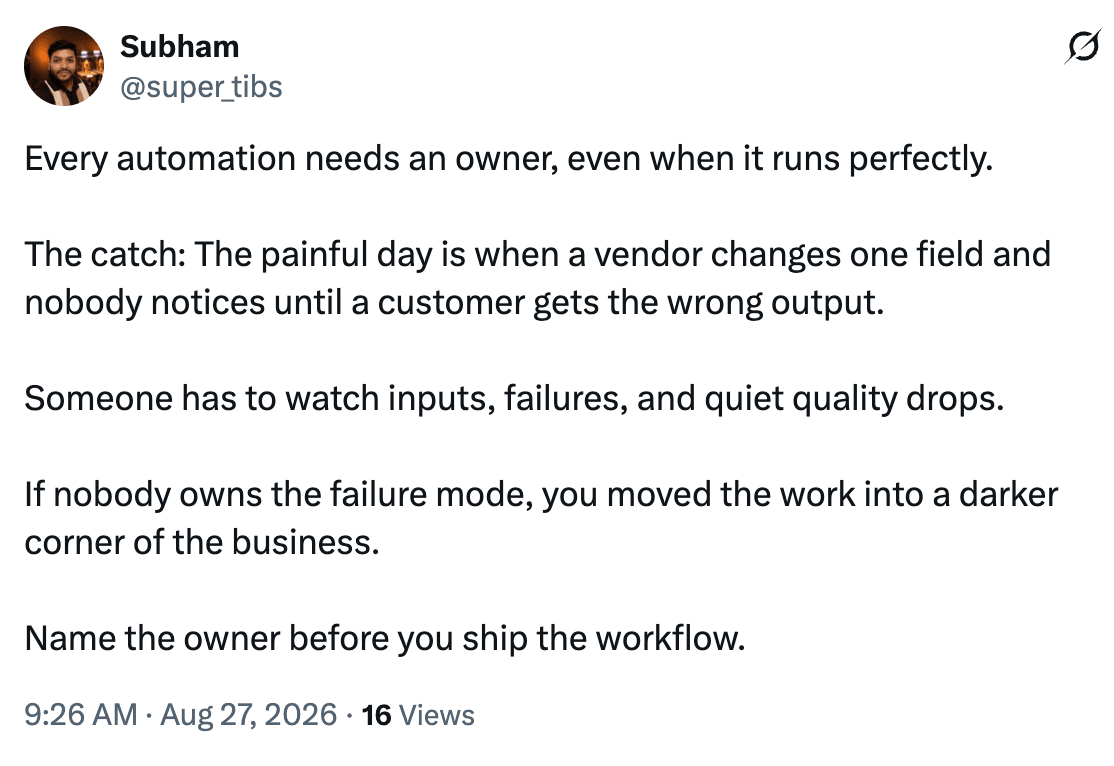
Unless responsibility has been established beforehand, automation can make an existing gap in ownership harder to see. The eventual outcome may simply be a frustrated customer, while internally no one is entirely clear about who was responsible for preventing the problem.
Research on RPA governance similarly finds that the way organisations design and implement governance plays an important role in how automation programmes perform.
The same applies to capability. A system working on launch day is not the end of an automation project, but the beginning of a process that will continue to change. Suppliers alter data formats, regulations evolve and new exceptions appear.
Someone needs enough knowledge to recognise when the automation no longer reflects the work it was designed to perform and to know what should happen next.
Why Automation Exposes Existing Business Problems
There is an uncomfortable possibility for businesses rushing towards AI-enabled automation: sometimes technology exposes problems that were already there.
Unclear ownership, inconsistent processes, undocumented workarounds, poor data and unrealistic expectations do not originate with an automation tool. Automation can simply make them harder to ignore.
This is why the most useful question before choosing a technology may not be “What can we automate?”
It may be “Do we understand what we are automating?”
References
- Costa, D. S., Mamede, H. S., & Mira da Silva, M. (2023). A method for selecting processes for automation with AHP and TOPSIS. Heliyon, 9(3), e13683. https://doi.org/10.1016/j.heliyon.2023.e13683
- Huynh, D.-M.-Q., & Lindgren, I. (2026). Beyond the hype of Robotic Process Automation (RPA): On conditions needed to implement RPA in organizations. Information Systems and e-Business Management. https://doi.org/10.1007/s10257-026-00721-0
- Kokina, J., Langmann, C., & Weiser, M. (2026). Navigating the RPA governance landscape: Evidence from the field. International Journal of Accounting Information Systems, 57, 100784. https://doi.org/10.1016/j.accinf.2026.100784
- Lammi, I. J. (2021). Automating to control: The unexpected consequences of modern automated work delivery in practice. Organization, 28(1), 115–131. https://doi.org/10.1177/1350508420968179